A Practical Guide to the Castles of Lake Garda
A complete list and map of the most famous castles of Lake Garda, where they are located and how to reach them.

Italy is undoubtedly the country that, more than any other, owns a historical and cultural heritage that is unique in the world. In every region, city or small village, we can find architectural treasures of inestimable value. The Middle Ages were a politically troubled period, but they left us a significant number of buildings that are visited by millions of tourists every year.
Obviously, this important historical period also left its mark on Lake Garda. From the northern to the southern part of the biggest Italian lake, there are still some medieval castles of remarkable beauty that outline the Garda landscape with their impressive presence.
The Scaligero Castle of Malcesine
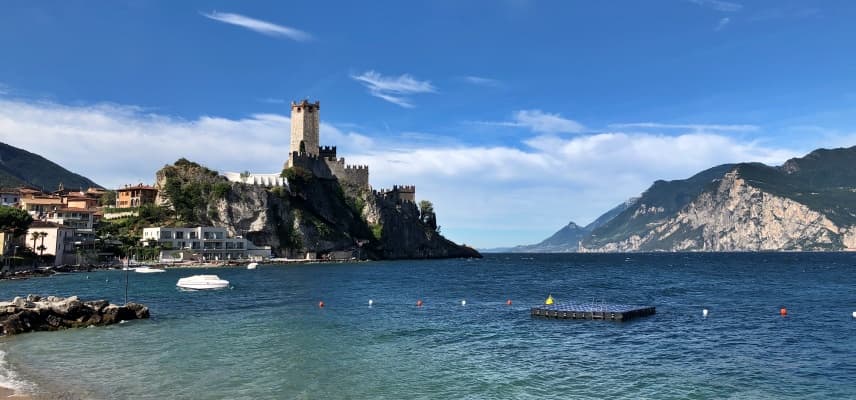
The Scaligero Castle of Malcesine is one of the most famous fortifications on Lake Garda. Its origins are ancient, and the first defensive structures probably date back to the Lombard era (8th century), although the complex has undergone numerous renovations and extensions over the centuries. The most significant phase in its history is linked to the domination of the Scala family, lords of Verona, who in the 13th and 14th centuries strengthened its defences and gave it the appearance that it still largely retains today.
The castle stands on a rocky spur overlooking the lake, in a strategic position for controlling both land and lake communication routes. This location made it a military garrison of great importance, contested over the centuries by various regional powers, including the Visconti of Milan, the Republic of Venice and, later, the Habsburg Empire.
The most impressive architectural feature is the keep, the main tower, which rises about 70 metres above the lake. From its summit, you can enjoy a wide panorama that encompasses the Garda basin, Monte Baldo and the surrounding mountain ranges.
Today, the castle is open to the public and can be visited for a fee. Inside, it houses the Natural History Museum of Garda and Monte Baldo, which illustrates the environmental and geological richness of the area through exhibits, explanatory panels and multimedia installations. The exhibition rooms allow visitors to learn more about the flora, fauna and geomorphological characteristics of the area, offering a complete picture of the relationship between man and the environment over the centuries.
In addition to its museum function, the Scaligero Castle of Malcesine preserves traces of its long history. The internal courtyards, crenellated walls, staircases and service areas bear witness to the architectural evolution of the fortress and its defensive role. In modern times, the structure has been restored and enhanced, becoming not only a place of historical memory but also one of the most sought-after locations for civil weddings, thanks to the charm of the setting and the evocative panorama.
Castello Scaligero di Malcesine
Municipality: Malcesine - Region: Veneto - Province: Verona - Condition: well-preserved, with the main parts of the structure intact - Accessibility: the courtyards and some rooms are easily accessible, whilst the walkways and the tower feature some steep staircases and are not suitable for people with disabilities - Visits: admission fee applies - Prices: adults €7, children €3 (aged 6–13, free for children aged 5 and under), concessions €5 - Opening hours: from 20 March 2026 to 22 May 2026 from 9.30 am to 6.30 pm; from 23 May 2026 to 27 September 2026 from 9.30 am to 7.30 pm, open until 10.00 pm on Fridays and Saturdays; from 28 September 2026 to 1 November 2026 from 9.30 am to 6.30 pm; last admission half an hour before closing time – Parking: Malcesine Castle can be reached on foot from the Statuto car park (6 minutes) or the Paina car park (10 minutes)

The Scaligero Castle of Torri del Benaco
The Scaligero Castle of Torri del Benaco is one of the most significant examples of medieval architecture along the eastern shore of Lake Garda. Its construction dates back to the era of the Scala family, lords of Verona, who between the 13th and 14th centuries reinforced numerous villages around Lake Garda with defensive structures designed to control the territory and protect the local populations.
The main function of the castle was to guard the ancient village of Torri del Benaco and defend it from possible incursions from both the lake and the valleys behind it. Its strategic position, in the centre of the Veronese Riviera, made it a military and administrative reference point for several centuries.
The building, which has been preserved in excellent condition, can now be visited for a fee. Inside, it houses an ethnographic museum, spread over several floors and divided into themed rooms that document the daily life, traditions and economic activities of the Garda area. The exhibition rooms contain work tools, artefacts and evidence related to fishing, agriculture, crafts and the social history of the local community.
A particularly interesting building is the lemon house on the south side of the castle, one of the few still existing on the eastern shore of Lake Garda. This structure, once used for growing citrus fruits, is a rare example of traditional agricultural architecture and bears witness to the importance of lemon production for the economy and landscape of the area. It is also open to visitors and is a fascinating stop for those who wish to understand the intertwining of history, nature and culture in the area.
Castello Scaligero di Torri del Benaco
Municipality: Torri del Benaco - Region: Veneto - Province: Verona - Condition: well-preserved, with the main parts of the structure intact - Accessibility: the courtyards, the lemon house and some of the rooms are easily accessible, whilst the walkways and towers feature some steep staircases and are not suitable for people with disabilities - Visits: admission fee applies - Prices: adults €6 - Opening hours: daily, open continuously from 9.30 am to 6.30 pm; last admission half an hour before closing - Parking: Torri del Benaco Castle can be reached on foot from the car park in Via Gardesana, 60 (5 minutes)

The Scaligero Castle of Lazise
The Scaligero Castle of Lazise, located on the eastern shore of Lake Garda, is one of the most significant examples of medieval fortified architecture in the Garda area. Its construction dates back to the era of the Scala family, lords of Verona, who between the 13th and 14th centuries equipped several coastal towns with powerful defensive structures.
Built to protect the town and its inhabitants from external incursions, the castle has undergone various alterations and adaptations over the centuries, while retaining its charm intact. Today, the structure is privately owned and not regularly open to visitors, but it continues to dominate the historic centre of Lazise with its imposing size and crenellated towers that mark its profile.
Large sections of the ancient walls that surrounded the town are still clearly visible, together with the main gates to the medieval town: Porta Cansignorio to the north, Porta San Zeno to the east and Porta Lion to the south. These perfectly preserved gates bear witness to the strategic importance of Lazise as a control point along the lake and land communication routes.
The fortified complex, although not currently used as a museum, is an important historical and architectural element that defines the identity of the town and preserves the memory of its medieval past.
Castello Scaligero di Lazise
Municipality: Lazise - Region: Veneto - Province: Verona - Condition: well-preserved, with the main parts of the structure intact - Accessibility: the interior is not open to the public; the castle is privately owned - Visits: entry not permitted - Prices: none - Opening hours: the castle can only be viewed from the outside - Parking: Lazise Castle can be reached on foot from the Marra car park (5 minutes) or the San Martino car park (10 minutes)

The Scaligero Castle of Sirmione
The Scaligero Castle of Sirmione is one of the best preserved medieval fortifications in Italy and still constitutes the main access point to the historic centre of the peninsula. Its construction dates back to the second half of the 13th century, during the rule of the Scala family, who built it as a military garrison and strategic control point on the lower Garda.
Its location is extraordinarily evocative, as the entire complex stands directly in the waters of the lake, surrounded by a moat fed by the waters of Lake Garda itself. This feature makes it a rare example of a lake castle, unique in Europe.
A distinctive feature of the structure is the fortified dock, an internal basin protected by walls and towers that served as a refuge for the Scaligeri fleet. It is one of the very few examples of medieval military ports still in existence and is a valuable testament to the naval power exercised by the Scaligeri family on the lake.
The castle is now open to the public and can be visited for a fee. The tour route leads through the inner courtyards, the corner towers and the crenellated walls, up to the keep, the main tower. From here, you can enjoy an exceptional panoramic view that encompasses the entire Sirmione peninsula, the waters of Lake Garda and, on clear days, the surrounding mountain ranges.
In addition to its architectural and military value, the Scaligero Castle of Sirmione has also taken on a strong symbolic and identity value for the town over time. Restored and enhanced in recent years, this castle is now one of the most visited monuments on the lake and is an essential destination for those who wish to understand the history and evolution of medieval Garda.
Castello Scaligero di Sirmione
Municipality: Sirmione - Region: Lombardy - Province: Brescia - Condition: well-preserved, with the main parts of the structure intact - Accessibility: the courtyards are easily accessible, whilst the walkways and towers feature some steep staircases and are not suitable for people with disabilities - Visits: admission fee applies - Prices: adults €8 - Opening hours: daily from 8:30 am to 7:15 pm, closed on Mondays; last admission 45 minutes before closing - Parking: Sirmione Castle can be reached on foot from the car park in Viale Guglielmo Marconi (5 minutes) or from the car park in Piazzale Europa (7 minutes)

The Castle of Desenzano del Garda
The Castle of Desenzano del Garda stands slightly above the level of the lake, dominating the entire town from above and offering a privileged vantage point over the southern basin of Lake Garda. Its origins probably date back to the early Middle Ages, when it was built as a defensive structure to protect the town and the surrounding communication routes. Over the centuries, the complex has undergone extensions and alterations, adapting to the different military and civil needs of successive eras.
The castle has a quadrangular layout, with corner towers reinforcing its structure. During the most recent restoration work, it was possible to recover and make accessible the walkways, which allow visitors to walk along the perimeter walls, and the climb to the keep tower, which offers a wide view of the town and the lake.
Throughout its history, the castle has been under various rulers: initially a medieval garrison, it was involved in the disputes between the Scaligeri and Visconti families, then became part of the Republic of Venice, which maintained its defensive function until modern times. Subsequently, with the arrival of Napoleonic and then Austrian troops, it gradually lost its military role, until it was destined for civilian use.
Today, the castle is open to the public and can be visited for a fee. The tour includes the walkways, the keep and the interior spaces, which periodically host theatrical performances, cultural events, concerts and temporary exhibitions. While retaining its medieval character, the structure has thus become a meeting place between historical memory and contemporary activities, combining heritage conservation with public use.
Castello di Desenzano del Garda
Municipality: Desenzano del Garda - Region: Lombardy - Province: Brescia - Condition: well-preserved, with the main parts of the structure intact - Accessibility: the courtyards and some rooms are easily accessible, whilst the walkways and towers contain some stairs and are not suitable for people with disabilities - Visits: admission fee applies - Prices: adults €8, children €5 (6–17 years old, free for children under 5), concessions €5 - Opening hours: from 1 May 2026 to 31 October 2026, open daily from 9.30 am to 12.30 pm and from Friday to Sunday from 9.30 am to 6.30 pm; closed on Mondays; from 1 November 2026 to 30 April 2027, open on Saturdays and Sundays from 9.30 am to 5.30 pm - Parking: Desenzano del Garda Castle can be reached on foot from the P1 Maratona car park (12 minutes) or from the Autosilo car park (15 minutes)

The Rocca of Lonato del Garda
The Rocca of Lonato del Garda is one of the most impressive fortifications on the southern shore of Lake Garda. Built on high ground above the village, it dominates the town and the surrounding area, and over the centuries has played a strategic role of primary importance. Its origins date back to the early Middle Ages, but the structure was enlarged and reinforced several times, particularly during the Scaliger period and later under Visconti and Venetian rule.
The fortress, with its vast perimeter walls and watchtowers, was a fundamental defensive bulwark for controlling the communication routes between the plain and the lake. Its position allowed it to monitor movements along the main commercial and military routes, making it a garrison contested by various regional powers.
Today, the fortress is open to the public and can be visited for a fee. Inside, it houses the "Gustavo Adolfo Carlotto" Civic Ornithological Museum, which has one of the richest collections in Italy dedicated to birdlife, with hundreds of specimens from the Garda area and beyond. The museum also has an educational function, offering insights into biodiversity and the evolution of naturalistic studies.
The Rocca is managed by the Ugo Da Como Foundation, which is also responsible for promoting the nearby Museo Casa del Podestà, a historic residence that preserves furnishings, works of art and a prestigious library. Together, these places constitute a cultural centre of great importance for the town of Lonato and the entire Garda area.
In addition to its function as a museum, the Rocca is now a location for cultural events, historical re-enactments and other events that bring its spaces to life, restoring vitality to a complex that, while deeply linked to its medieval past, continues to be a point of reference for the community and visitors alike.
Rocca di Lonato del Garda
Municipality: Lonato del Garda - Region: Lombardy - Province: Brescia - Condition: well-preserved, with the main parts of the structure intact - Accessibility: the courtyards and main areas are easily accessible, whilst the upper levels involve some steps and are not suitable for people with disabilities - Visits: admission fee applies - Prices: adults €6, over-65s reduced rate €5, under-14s reduced rate €4 - Opening hours: from March to October, open daily from 10.00 am to 6.00 pm; from November to February, open on Saturdays and Sundays from 10.00 am until sunset - Parking: the Rocca di Lonato del Garda can be reached on foot from the Corlo car park (5 minutes) or from the Torre car park (7 minutes)

The Castle of Drugolo
The Castle of Drugolo, also known as Castle Averoldi, is located in the municipality of Lonato del Garda, slightly north of the town centre. Its origins date back to the Middle Ages, when it was built as a defensive stronghold to protect the surrounding countryside and the roads that crossed the Garda hinterland.
The structure, characterised by a typically medieval layout with corner towers and walls, has maintained a compact and harmonious appearance over time. Although not open to the public as it is privately owned, the castle is in excellent condition and continues to be a landmark in the landscape and history of the area.
Over the centuries, the complex passed through the hands of various noble families, including the Averoldi family, who owned it for a long time and to whom it owes one of its most common names. Its defensive function gradually declined as military needs changed, but the castle retained an important role as a stately residence and centre for the management of the territory's agriculture.
Today, although it is not open to visitors, the Drugolo Castle remains a significant example of the fortification system that marked the lower Garda area and helped define the political and military structure of the area in medieval times. Its presence, clearly visible from the outside, makes it worthy of mention within the historical and architectural heritage of Garda.
Castello di Drugolo
Municipality: Lonato del Garda - Region: Lombardy - Province: Brescia - Condition: well-preserved, structurally intact and in excellent condition - Accessibility: the interior is not open to the public; the castle is privately owned - Visits: entry not permitted - Admission fees: none - Opening hours: the castle can only be viewed from the outside - Parking: Drugolo Castle can be reached on foot from the car park on Via Cuccagna in Sedena (20 minutes)

The Castle of Padenghe sul Garda
The Castle of Padenghe sul Garda stands on a hill, dominating the entire surrounding landscape and offering a wide view of the southern part of the lake. Its origins date back to the early Middle Ages, probably between the 9th and 10th centuries, when it was built as a defensive stronghold against barbarian incursions and to protect the local population.
The structure, which was enlarged and reinforced in subsequent centuries, still retains the appearance of a typical medieval fortification. The layout is irregular, adapted to the terrain, and is enclosed by sturdy walls punctuated by square towers. Inside the perimeter are several private homes, evidence of the complex's continued use as a residential area even after it lost its military function.
The castle can be visited free of charge and is one of the most evocative attractions in the area. The tour itinerary allows visitors to access the defence tower, about 20 metres high, from which they can enjoy a spectacular view that encompasses the entire southern part of Lake Garda and, on clear days, extends to the surrounding plain.
Throughout its history, Padenghe Castle has been under various rulers, including the Scaligeri, the Visconti and the Republic of Venice, who recognised its strategic importance as a control point for the Garda area. With the gradual change in military requirements, the fortress lost its defensive function but remained a vital centre for the local community.
Today, while retaining its medieval character, the castle is a place that combines historical memory and public fruition, offering visitors the opportunity to immerse themselves in an authentic setting and admire one of the most wide-ranging and evocative views of the lower Garda area.
Castello di Padenghe sul Garda
Municipality: Padenghe sul Garda - Region: Lombardy - Province: Brescia - Condition: well-preserved, with the main parts of the structure intact - Accessibility: the village within the walls is open to visitors, whilst the tower has several flights of stairs and is not suitable for people with disabilities - Visits: free entry - Admission fees: none - Opening hours: the tower and the theatre are open from 9.00 am to 9.00 pm in summer and from 9.00 am to 6.00 pm in winter - Parking: Padenghe sul Garda Castle can be reached on foot from the car park in Via Castello (1 minute)

The Rocca of Manerba del Garda
The Rocca of Manerba del Garda is located within the Archaeological and Naturalistic Park of the same name, a protected area that combines landscape conservation with the enhancement of historical heritage. Its location, on a rocky promontory jutting out into the lake, is one of the most picturesque in the entire Garda area and offers a privileged vantage point over the southern basin and the islands of San Biagio and Garda.
The origins of the fortress date back to the early Middle Ages, when it was built as a fortification to defend the village and the lake communication routes. In the following centuries, it was repeatedly contested and the scene of clashes between various regional powers, including the Lombards, the Franks, the Scaligeri and, later, the Republic of Venice. Its strategic position made it a key stronghold for controlling the territory and trade routes.
Today, all that remains of the fortress are the ruins of the walls and towers, which bear witness to the ancient defensive structure and allow us to reconstruct, at least in part, the original appearance of the complex. The area has been the subject of archaeological excavations that have brought to light finds from different periods, now preserved and exhibited in the nearby civic museum.
The Rocca of Manerba is now a popular tourist destination, not only for its historical value, but also for the natural environment that surrounds it. The trails in the park lead visitors through scenic routes and areas of archaeological interest, offering an experience that combines nature, history and culture. The promontory is also a strategic observation point, from which you can admire one of the most spectacular and wide-ranging views of Lake Garda.
Rocca di Manerba del Garda
Municipality: Manerba del Garda - Region: Lombardy - Province: Brescia - Condition: a well-preserved archaeological site featuring the remains of the fortification and extensive panoramic viewpoints - Accessibility: the main paths are easily accessible, whilst the higher areas have steep sections and are not suitable for people with disabilities - Visits: free entry - Admission fees: none - Opening hours: open all year round - Parking: the Rocca di Manerba del Garda can be reached on foot from the car park in Via della Rocca (5 minutes) or from the car park in Via Agello (20 minutes)

The Castle of Moniga del Garda
The Castle of Moniga del Garda is part of the dense network of medieval fortifications that characterise the Valtenesi area, along the south-western shore of Lake Garda. Its construction probably dates back to between the 9th and 10th centuries, a period marked by barbarian incursions and the need to defend local communities.
Built with the specific purpose of protecting the population and offering refuge in case of attack, the castle has an irregular layout, adapted to the terrain, and is surrounded by sturdy walls punctuated by watchtowers. Inside the fortified area, there are still some private homes, evidence of the complex's continued use as a residential centre even after it lost its military function.
Outside, the castle is surrounded by a large public park, which enhances its presence and allows its grandeur to be admired from different perspectives. This green space, which is very popular with residents and visitors alike, helps to integrate the fortress into the contemporary urban landscape, transforming it into a place for people to meet and enjoy together.
Over the centuries, the Castle of Moniga came under various rulers, including the Scaligeri, the Visconti and the Republic of Venice, who recognised its strategic importance as a territorial stronghold. With the gradual change in defensive requirements, the structure lost its original function but remained a landmark for the local community.
Today, the castle is an element of high historical and architectural value, capable of recounting the long fortified tradition of Valtenesi and at the same time offering an evocative context for those who wish to discover the medieval face of Lake Garda.
Castello di Moniga del Garda
Municipality: Moniga del Garda - Region: Lombardy - Province: Brescia - Condition: well preserved, with the main parts of the structure intact - Accessibility: the village within the walls is open to visitors - Visits: free entry - Admission fees: none - Opening hours: open all year round - Parking: Moniga del Garda Castle can be reached on foot from the car park in Via San Giovanni, 26 (8 minutes)

The Castle of Arco
The Castle of Arco dominates the town of the same name and the entire Sarca river valley from above, thanks to its strategic position on top of an imposing limestone cliff. The origins of the fortification date back to the early Middle Ages, but its current appearance is the result of extensions and alterations that took place mainly between the 12th and 15th centuries, when the castle was at the centre of disputes between the main regional powers.
The structure, spread over several levels, includes towers, crenellated walls and the remains of residential areas that bear witness to the complex's dual defensive and residential function. Particularly impressive are the Torre Grande and Torre Renghera towers, which still today tell the story of the noble Arco family, long linked to the fortress's history.
Over the centuries, the castle passed under the control of the Scaligeri, the Visconti and the Republic of Venice, until it entered the orbit of the Habsburg Empire, undergoing sieges and partial destruction that marked its appearance. With the gradual decline of its military function, the castle was abandoned and only in modern times it has been restored and promoted as a historical heritage site.
Today, the castle is open to visitors for a fee and represents one of the most popular destinations for a day trip. The tour route leads through the remains of the ancient structures to the highest viewpoints, from which you can enjoy spectacular views of the Sarca valley, the surrounding mountains and the northern part of Lake Garda.
Castello di Arco
Municipality: Arco - Region: Trentino-Alto Adige - Province: Trento - Condition: partially preserved ruin with a fragmented structure - Accessibility: the uphill path has some steep sections and is not suitable for people with disabilities - Visits: admission fee applies - Prices: adults €5, over-65s reduced €3.50, young people aged 12 to 18 reduced €3.50, children under 12 free - Opening hours: from 1 April 2026 to 1 October 2026 from 10:00 am to 7:00 pm; from 2 October 2026 to 31 October 2026 from 10.00 am to 5.00 pm; from 2 November 2026 to 6 January 2027 from 10.00 am to 4.00 pm – Parking: Arco Castle can be reached on foot from the car park in Via del Calvario, 4 (20 minutes) or from the car park in Via della Cinta, 32 (30 minutes)

The Castle of Tenno
The Castle of Tenno, located a few kilometres from Riva del Garda, is one of the most significant examples of medieval fortification in the Trentino area. Its dominant position, on a rocky spur overlooking the village, underlines its defensive and territorial control function since its origins.
Probably built between the 12th and 13th centuries, the castle was the scene of clashes and disputes over the centuries, mainly related to control of the Sarca valley and the roads leading to Lake Garda. Its history is closely linked to the prince-bishops of Trento, who held sway over it for a long time, and later to the Habsburg Empire, under which it remained until modern times. These dominations, alternating with periods of local autonomy and conflicts with neighbouring communities, have marked its structure and strategic function.
The complex, characterised by an irregular layout adapted to the morphology of the terrain, still preserves towers and sections of walls that are evidence of its original majesty. Although privately owned and not open to visitors, the castle is in excellent condition and remains a scenic and historical landmark for the Garda Trentino area.
Its profile, clearly visible even from a distance, continues to evoke the strategic role it played in the Middle Ages and makes it worthy of mention within the fortification system of the Lake Garda area.
Castello di Tenno
Municipality: Tenno - Region: Trentino-Alto Adige - Province: Trento - Condition: well-preserved, structurally intact and in excellent condition - Accessibility: the interior is not open to the public; the castle is privately owned - Visits: entry not permitted - Admission fees: none - Opening hours: the castle can only be viewed from the outside - Parking: Tenno Castle can be reached on foot from the car park in Via dei Laghi (5 minutes)

Castel Penede
Castel Penede, located in the municipality of Nago-Torbole, stands on a rocky spur overlooking the northern entrance to Lake Garda and the Sarca valley. Its strategic position made it a garrison of great importance for centuries, capable of controlling the connections between the Garda area and the routes to Trentino and the Adige.
The origins of the castle date back to the Middle Ages, probably between the 12th and 13th centuries, when it was built as a fortification to defend the village and trade routes. In the following centuries, the castle was at the centre of numerous disputes: it belonged to the Counts of Arco, then passed under the influence of the prince-bishops of Trento and, later, was involved in the struggles between the Republic of Venice and the Habsburg Empire, which led to sieges and destruction. These events led to the gradual decline of the structure, until it was abandoned.
Today, only the ruins of the walls and towers of Castel Penede remain visible, but they still preserve the charm of the place. The area can be visited freely and represents an ideal destination for short walks through meadows and wooded areas leading to the promontory. From here, there is a spectacular view of the lake, Torbole and the Sarca valley, making a visit to the castle an experience that combines nature, history and landscape.
Castel Penede
Municipality: Nago-Torbole - Region: Trentino-Alto Adige - Province: Trento - Condition: ruins with a fragmented structure - Accessibility: the climb is easy, but the area around the ruins has an uneven surface and is not suitable for people with disabilities - Visits: free entry - Admission fees: none - Opening hours: open all year round - Car parks: Castel Penede can be reached on foot from the car park in Via Del Trenim (30 minutes)

Map of the Castles of Lake Garda
Click on the button below to open the detailed map of Lake Garda castles.
What to see on Lake Garda
Many other sights await you, discover them below!